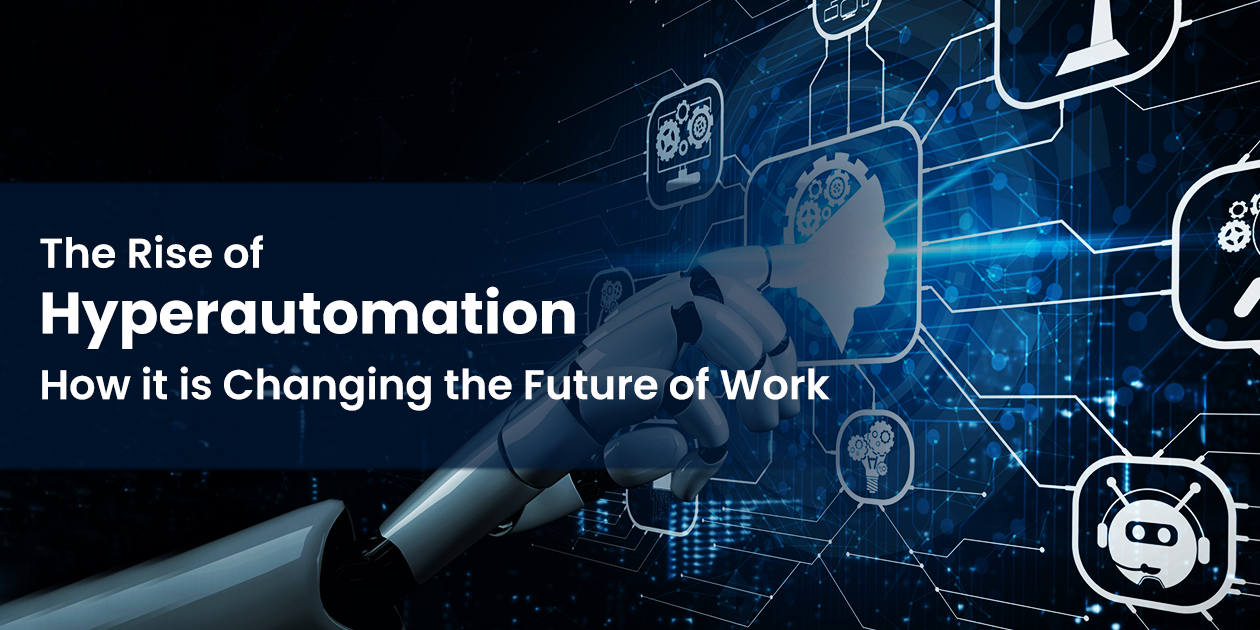
The Rise of Hyperautomation: How It is Changing the Future of Work

The Rise of Hyper automation How Its Changing the Future of Work - 1260 x 630

Introduction

The world of work is undergoing a seismic shift. Driven by the relentless march of technological advancement, automation is no longer a futuristic concept but a present-day reality. While traditional automation focused on specific tasks, a new paradigm is emerging: hyperautomation. This powerful combination of advanced technologies is not just automating individual processes; it’s transforming entire workflows and fundamentally reshaping the future of work as we know it.
 

What is Hyperautomation? 

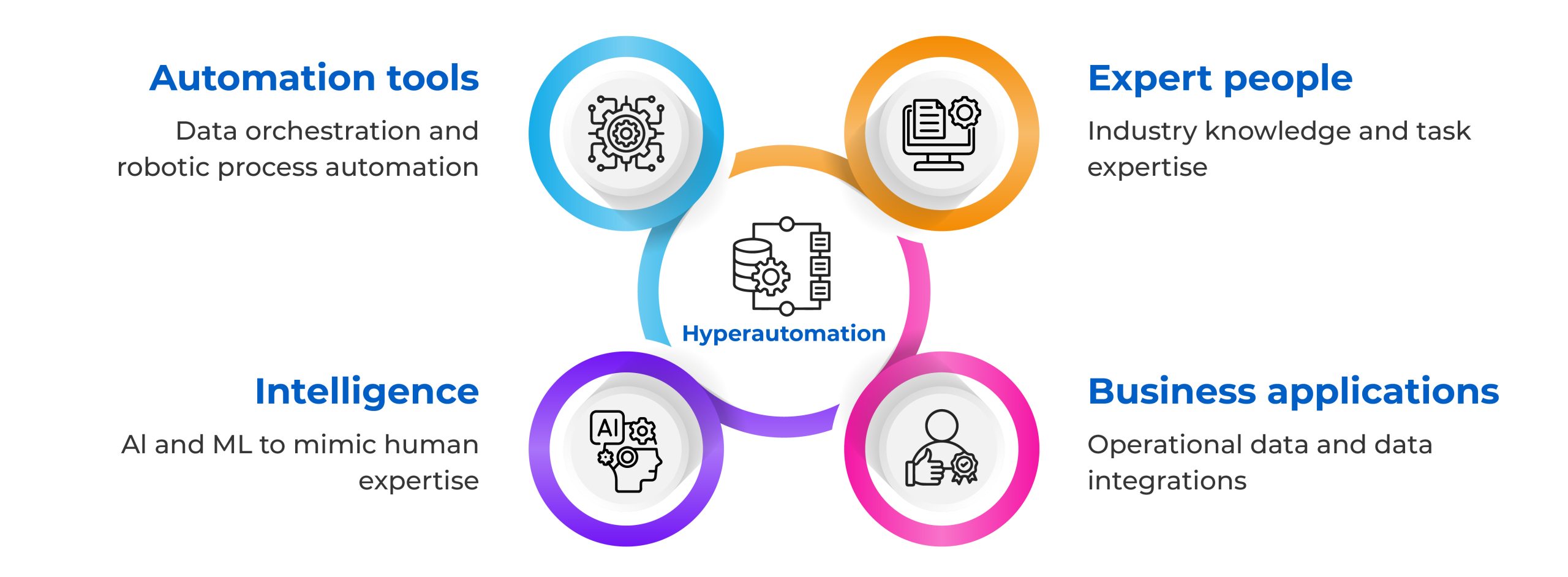
Hyperautomation isn’t simply automation on a grander scale. It represents a more sophisticated and integrated approach. It’s the orchestrated use of multiple advanced technologies, including: 

  • Robotic Process Automation (RPA): Software robots that automate repetitive, rule-based tasks, mimicking human interaction with computer systems. 
  • Artificial Intelligence (AI) and Machine Learning (ML): AI and ML empower systems to learn from data, make decisions, and adapt to changing circumstances, enabling automation of more complex and cognitive tasks. 
  • Business Process Management (BPM) and Intelligent Business Process Management Suites (iBPMS): These tools help model, manage, and optimize business processes, providing a framework for automating end-to-end workflows. 
  • Integration Platform as a Service (iPaaS): iPaaS connects disparate systems and applications, enabling seamless data flow and integration across the organization, crucial for hyperautomation initiatives. 
  • Low-Code/No-Code Platforms: These platforms empower business users to build and deploy automated solutions without extensive coding knowledge, democratizing automation and accelerating its adoption. 
  • Decision Management Platforms: These platforms automate complex decision-making processes based on predefined rules and analytics, improving efficiency and consistency. 

Hyperautomation goes beyond automating individual tasks; it orchestrates these technologies to automate entire workflows, from start to finish. It’s about creating a digital workforce that can handle a wide range of tasks, freeing up human employees to focus on more strategic and creative endeavours. 

How Hyperautomation is Changing the Future of Work

The rise of hyperautomation is having a profound impact on the future of work, reshaping roles, skills, and organizational structures. Here are some keyways it’s changing the landscape: 

  • Evolution of Job Roles: As hyperautomation takes over routine and repetitive tasks, human roles are evolving. The focus is shifting towards higher-value activities that require critical thinking, creativity, problem-solving, and emotional intelligence – skills that are uniquely human. We’re seeing a rise in demand for roles like data scientists, automation specialists, process analysts, and AI trainers. 
  • Increased Productivity and Efficiency: By automating complex workflows, hyperautomation significantly boosts productivity and efficiency. Organizations can achieve more with fewer resources, leading to cost savings and improved competitiveness. This translates to faster turnaround times, improved quality, and increased output. 
  • Enhanced Decision-Making: Hyperautomation leverages AI and analytics to provide data-driven insights, enabling more informed and strategic decision-making. Automated decision management platforms can analyze vast amounts of data to identify patterns, predict trends, and optimize decisions in real time. 
  • Improved Customer Experience: Hyperautomation can personalize customer interactions, automate customer service processes, and provide faster and more efficient service. Chatbots, AI-powered virtual assistants, and automated email marketing campaigns are just a few examples of how hyperautomation is enhancing the customer experience. 
  • Creation of New Opportunities: While some jobs may be displaced by automation, hyperautomation is also creating new opportunities in areas like AI development, automation engineering, and data science. It’s driving innovation and creating new industries and business models. 
  • Focus on Upskilling and Reskilling: To thrive in the age of hyperautomation, workers need to adapt and develop new skills. Upskilling and reskilling initiatives are crucial to equip the workforce with the competencies needed to work alongside automation technologies. This includes developing skills in areas like data analysis, critical thinking, problem-solving, and digital literacy. 
  • Transformation of Organizational Structures: Hyperautomation is driving organizational restructuring, with flatter hierarchies and more agile teams. Organizations are becoming more data-driven and process-centric, with a greater emphasis on collaboration and cross-functional teamwork. 
  • Increased Agility and Adaptability: Hyperautomation enables organizations to respond quickly to changing market conditions and customer demands. Automated workflows can be easily modified and adapted, allowing businesses to remain agile and competitive in a dynamic environment. 
  • Ethical Considerations: The rise of hyperautomation raises important ethical considerations, such as job displacement, bias in AI algorithms, and data privacy. Organizations need to address these issues proactively to ensure responsible and ethical use of automation technologies. 

Hyperautomation’s Expanding Horizons 

The future of hyperautomation is bright, with ongoing advancements in AI, ML, and other related technologies. We can expect to see: 

  • More sophisticated AI and ML: AI and ML algorithms will become even more sophisticated, enabling automation of increasingly complex and cognitive tasks. 
  • Greater integration: Hyperautomation technologies will become even more tightly integrated, creating seamless end-to-end automation of business processes. 
  • Increased adoption across industries: Hyperautomation will expand beyond its current strongholds and be adopted across a wider range of industries, from healthcare and finance to manufacturing and retail. 
  • Human-machine collaboration: The future of work will be characterized by greater collaboration between humans and machines, with humans focusing on high-value tasks and machines handling routine and repetitive activities. 


Conclusion

Hyperautomation is not just a technological trend; it’s a fundamental shift in the way work is done. It’s transforming industries, reshaping job roles, and creating new opportunities. While the transition may present challenges, the potential benefits of hyperautomation are immense.  

By embracing this transformative technology and focusing on upskilling and reskilling the workforce, organizations can unlock new levels of productivity, efficiency, and innovation, paving the way for a more prosperous and fulfilling future of work.  

The key to success lies in understanding the potential of hyperautomation, adopting a strategic approach to its implementation, and preparing the workforce for the changing demands of the digital age. APPSistem empowers organizations to navigate this complex landscape. Our expert consultants can help you develop a tailored hyperautomation strategy, implement the right technologies, and upskill your workforce to thrive in the age of intelligent automation.  

Contact us to unlock the full potential of hyperautomation for your business.